Buyers Need a Second-Home Exit Plan, Not Just a Rental Strategy

Todd Hudson
Team Lead & Lead Listing Specialist, The 808 Team at Keller Williams Maui Realty
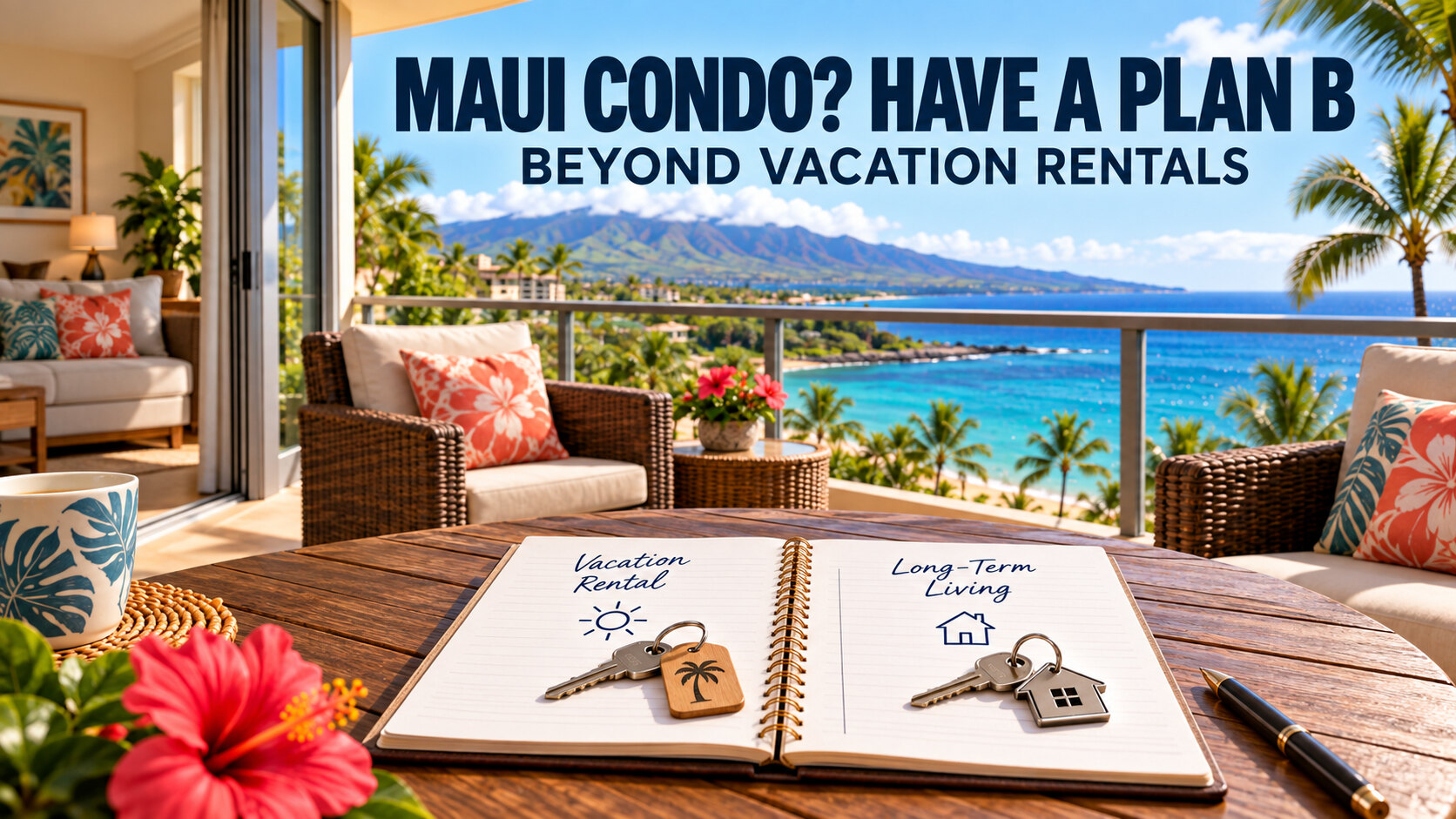
If you’re buying Maui real estate and your entire plan depends on vacation-rental income forever, you’re not investing. You’re gambling on regulation.
The smarter play is simple: buy a property that still works if short-term rentals get restricted, reduced, or disappear altogether. That means every buyer should have a second-home exit plan before they ever fall in love with the view.
Key Takeaways
- A strong Maui condo purchase should work in more than one use case: vacation rental, second home, mid-term rental, or long-term hold.
- If your deal only pencils as a short-term rental, your risk is higher than most buyers admit.
- Regulatory uncertainty matters, especially in complexes affected by changing vacation-rental rules.
- The best properties have lifestyle value even without maximum rental income.
- Ocean view, floor level, layout, airflow, parking, AC, washer/dryer, and overall livability all matter in an exit-plan analysis.
- Two-bedroom units often have more flexibility than studios or smaller one-bedrooms because they appeal to more buyer types.
- Fee simple ownership, durable construction, and strong location access can improve long-term holding power.
- You should evaluate every purchase with one question: Would I still want this property if I couldn’t run it as a vacation rental five years from now?
What Is a Second-Home Exit Plan?
A second-home exit plan is your backup use strategy if the property stops performing as a short-term rental or can no longer legally operate that way.
It matters because Maui buyers are not just buying square footage. They’re buying into zoning, regulation, operating costs, local politics, and long-term usability. The goal is to own something that still makes sense even if the market changes.
Why Rental Strategy Alone Is Too Narrow
A lot of buyers start with one question: How much can this make on Airbnb or VRBO?
That’s not the wrong question. It’s just incomplete.
The better question is this: If rental rules change, would this still be a property I’d be happy to own? If the answer is no, that’s a red flag. Purchase price is only the beginning. Your real risk shows up when your original plan gets tested.
In Hawaii, especially in condo markets tied to visitor demand, regulations can reshape value faster than buyers expect. If your whole thesis is “I’ll rent it nightly for the next 20 years,” you may be building on sand.
What a Smart Exit Plan Actually Looks Like
A good exit plan means the condo still fits one of these paths:
- A true second home you’d personally enjoy using
- A long-term rental with acceptable hold economics
- A mid-term rental for traveling professionals or seasonal stays
- A lifestyle asset you keep because the location and experience still justify ownership
That’s the difference between a resilient purchase and a one-dimensional one.
How to Evaluate a Maui Condo the Right Way
The simplest rule I follow is this: Buy for flexibility, not just peak income.
Here’s how to pressure-test a property before you buy.
1. Ask Whether You’d Want to Use It Yourself
If you wouldn’t enjoy staying there without rental income, slow down.
A real second-home candidate should have enough personal-use value that you’d still be excited to own it. That usually comes down to the things buyers feel immediately but often underweight on a spreadsheet:
- View quality
- Privacy
- Wind exposure
- Noise
- Walkability
- Convenience to the airport, shops, harbor, beaches, and daily needs
- Comfort of the layout
- Building atmosphere
This is where oceanfront properties can separate themselves. If the property gives you panoramic views, whale watching in season, sunrise exposure, and a strong daily living experience, that creates value even outside a pure rental model.
2. Look at Regulatory Risk Like It’s Real, Because It Is
If a complex sits in a category where future vacation-rental use is uncertain, you need to underwrite that risk now, not later.
That doesn’t automatically make the property bad. It just means you need a different mindset. You’re not only buying a vacation rental. You may be buying a future second home, a mid-term rental, or a long-term hold while rules evolve.
The decision rule is simple:
- If the condo only works as a legal short-term rental, be cautious
- If the condo still works as a second home or alternate rental use, the risk is more manageable
That’s how smart buyers stay in control when headlines change.
3. Prioritize Unit Types With Broader Appeal
Not all units have the same exit strength.
In most Maui condo complexes, the unit mix matters a lot. Studios can be affordable and efficient, but they usually appeal to a narrower buyer pool. One-bedrooms often work well for couples, but they still have limits. Two-bedrooms typically give you the most flexibility because they can serve families, shared travel groups, part-time owners, or future occupants who want more functional living.
In plain English: the more ways a unit can be used, the safer your exit plan tends to be.
That doesn’t mean every two-bedroom is automatically better. It means unit type should be analyzed through future usability, not just current nightly rate potential.
4. Study the Floor and Position, Not Just the Unit Number
In oceanfront buildings, floor level and unit placement can dramatically change the ownership experience.
That affects:
- Ocean view quality
- Privacy
- Exposure to wind
- Noise from common areas or nearby activity
- Natural light
- Airflow
- Elevator dependence
- Rental desirability
- Resale appeal
End units often deserve extra attention because they may offer additional windows, better airflow, more privacy, and broader sight lines. That can matter a lot if the property shifts from investor ownership toward second-home or owner-user demand.
A mediocre unit in a good building is still a mediocre unit. Buyers need to stop underwriting the complex and start underwriting the exact residence.
5. Evaluate Livability Features That Matter in a Non-Rental Future
Here’s where many buyers get lazy. They assume if a place books well now, it must be a good long-term hold. Not true.
A condo that transitions well into second-home or longer-stay use usually benefits from practical features like:
- Washer and dryer
- Functional kitchen
- Updated bathrooms
- Solid flooring
- Good windows and sliding doors
- Comfortable sleeping configuration
- Split-system AC, if needed
- Strong natural ventilation
- Durable construction
- Good sound control
These aren’t glamorous talking points, but they matter. If you’re forced to rely less on short-term guest turnover and more on owner enjoyment or longer occupancy, these features become a bigger part of value.
6. Know the Difference Between “Oceanfront” and “Beachfront Lifestyle”
This is a big one.
Some buyers hear “oceanfront” and instantly assume swimmable sandy beach right out front. That’s not always the case. A building can sit directly on the ocean and still offer a different kind of experience than a classic sandy-beach property.
That doesn’t make it worse. It just makes it different.
For many buyers, oceanfront views, whale watching, harbor activity, sunrise exposure, and easy access to nearby beaches are enough. For others, if they can’t walk right onto a swimmable sandy beach, the property loses lifestyle value.
You need to know which buyer you are before you buy.
7. Underwrite the “Hold Through Change” Scenario
A lot of owners don’t sell immediately when regulations change. They hold.
That means your backup plan might not be an instant pivot. It may be a period where the complex gradually shifts toward more second-home owners, more long-term residents, more mid-term occupancy, and slower price discovery while the market figures things out.
If you buy right, that’s survivable.
If you buy a property that only made sense at peak nightly income assumptions, that holding period can get painful fast.
A Good Example of the Right Mindset
Let’s say you’re looking at an oceanfront condo in Ma’alaea with strong views, fee simple ownership, elevators, durable concrete construction, a pool, gathering areas, and easy access to the harbor, Central Maui, Kihei, and the airport.
That can be attractive as a vacation rental. But the better question is whether it also works as a second home.
If the answer is yes because you love the panoramic bay view, the whale watching, the sunrise exposure, the central location, and the lower-maintenance condo lifestyle, then you’re in a much stronger position. You’re not trapped in one strategy.
That’s exactly the kind of flexibility buyers should be paying for.
Common Mistakes Buyers Make
1. Buying based only on pro forma income
Projected rental numbers are not a safety plan. They’re a forecast.
2. Ignoring zoning and regulatory exposure
If you don’t understand the use rules, you don’t understand the asset.
3. Overvaluing “tourist appeal” and undervaluing “owner appeal”
A property can photograph well online and still be a weak second-home candidate.
4. Failing to inspect the exact livability details
Windows, doors, airflow, AC, noise, and floor level matter more than buyers think.
5. Assuming all oceanfront condos carry the same value
They don’t. Oceanfront, beachfront, harbor-adjacent, windy, walkable, and quiet are all different experiences.
How I’d Pressure-Test a Purchase Before Making an Offer
If you’re serious about buying, use this checklist:
- Can I still justify owning this if short-term rentals end in this complex?
- Would I personally enjoy using this as a second home?
- Does this unit have broad enough appeal for resale?
- Is the layout flexible enough for couples, families, or longer stays?
- Are the views, privacy, and floor level strong enough to support future demand?
- Does the property offer comfort features that matter beyond vacation use?
- Am I buying fee simple or leasehold?
- What happens to my numbers if I shift from short-term to mid-term or long-term use?
- Can I hold this through a regulatory transition without being forced to sell?
If you can’t answer those clearly, you’re not ready to buy yet.
Frequently Asked Questions
Why is a second-home exit plan important in Maui?
Because vacation-rental rules can change, and buyer demand shifts with them. A second-home exit plan protects you from being dependent on one use strategy.
Does this mean vacation-rental condos are a bad investment?
No. It means you should buy selectively. Vacation-rental income can still be part of the strategy, but it should not be the only reason the property makes sense.
Are two-bedroom units usually safer than studios?
Often, yes, because they appeal to more types of users. But unit quality, floor level, view, condition, and building rules still matter.
Should I avoid complexes with regulatory uncertainty?
Not automatically. Some can still be strong buys if they have real second-home value, good location fundamentals, and flexible future use.
What matters most in a backup-use analysis?
Livability, location, ownership structure, alternate rental potential, and whether you’d actually want to keep the property for personal use.
Next Steps
If you only do three things before buying a Maui condo, do these:
- Verify the current legal use and understand the regulatory risk
- Decide whether the property truly works as a second home for you
- Run the numbers under more than one occupancy strategy
That’s the shift buyers need to make right now. Stop buying only for the best-case rental scenario. Start buying for flexibility, durability, and a usable fallback plan.
Final Thoughts
The smartest real estate investors always think about the exit before they buy the entry.
In Maui, that means looking past short-term rental excitement and asking a tougher question: Would this still be a good property to own if the rules changed?
If the answer is yes, you’re probably looking at something solid. If the answer is no, keep shopping. The right property should give you income potential and a credible Plan B. In this market, that’s not optional. That’s just smart buying.
Questions about Maui real estate?
Reach Todd directly to talk through your situation.
Contact Todd